

🌱 Soil Doesn’t Lie:
Why Pasture-Raised Cattle Are Greener Than Cornfields

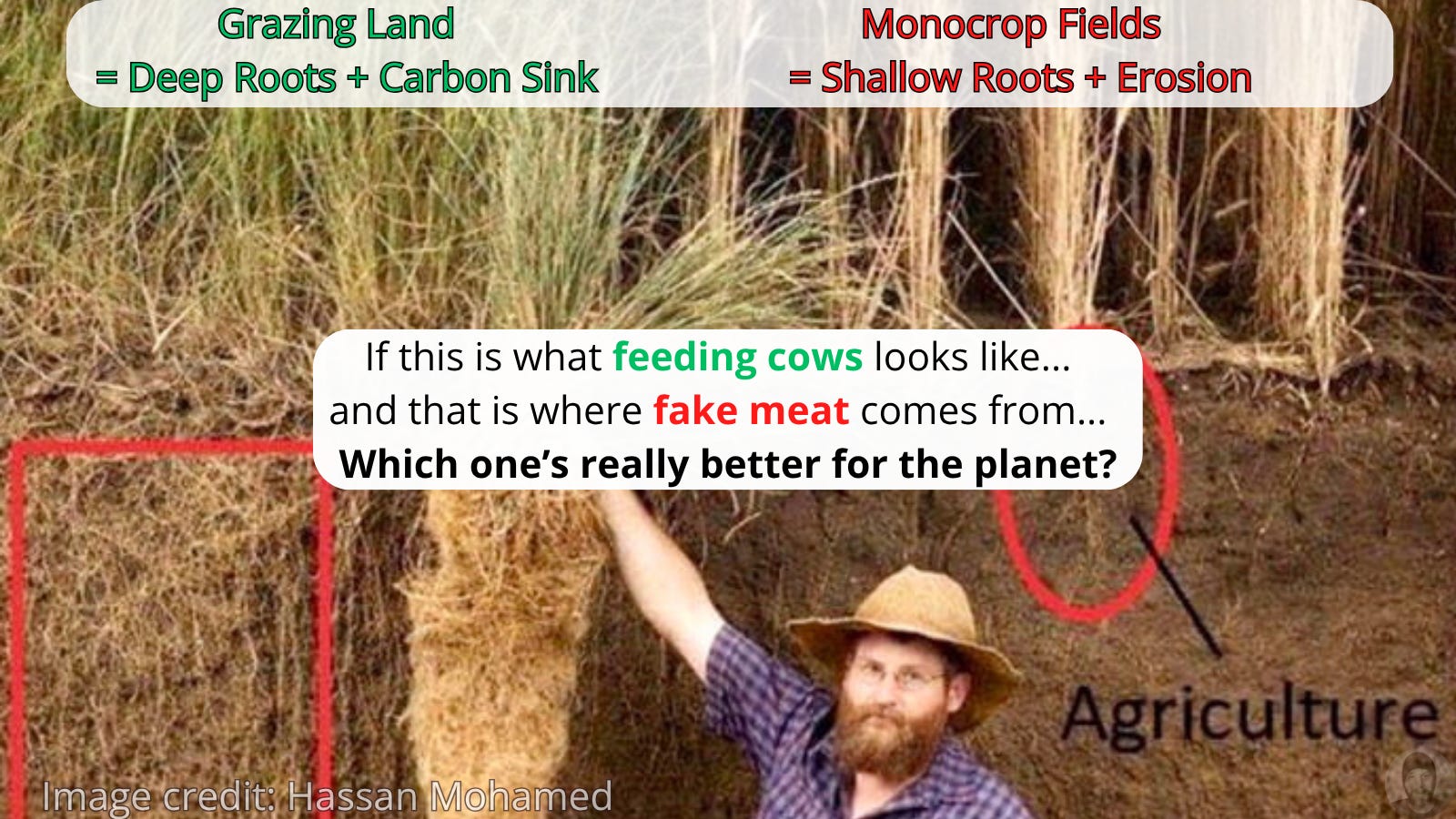
Image credit: Hassan Mohamed (visual adaptped)
Title: Agricultural Damages – A Tale of Two Roots
When we talk about the environment, we're often handed a spreadsheet. Emissions this, CO₂ that, net-zero by this date, carbon credits by that date. But there’s a deeper truth — one that lies beneath our feet, not in our formulas.
The image above tells a story most climate reports ignore.
On the left, nature shows off. Deep, complex root systems. Rich organic matter. A living carbon sink in action — not a theory, not a projection, but a living legacy of regeneration. That is what healthy, native grasslands look like.
On the right, we see industrial agriculture. Shallow roots. Compacted, nearly lifeless topsoil. This is where monocultures like corn and soy are grown — often destined for ultra-processed food or, ironically, fake meat. The carbon is not stored; it’s released. The soil is not nourished; it’s degraded. This is not a farm — it’s a carbon source and a dust factory.
🐄 Enter the Cow: Nature’s Soil Engineer
Contrary to popular belief, cattle aren't the enemy of the environment — how we raise them is. Cows raised on pasture (or fed harvested grass) are not only carbon neutral, but potentially carbon negative. Why?
Their manure fertilizes the soil naturally.
Their grazing stimulates root growth and grass diversity when done properly.
Their presence mimics wild herds, promoting biodiversity and soil health.
Pasturelands with cattle can store more carbon than degraded croplands ever will.
Monocropping, on the other hand, demands:
Massive tilling (which destroys microbial life),
Synthetic fertilizers (which burn fossil fuels and leach into waterways),
Pesticides (which kill off insects and pollinators),
And year-on-year depletion of topsoil — our planet’s most precious resource.
📉 Experts vs Ecosystems
The so-called “experts” pushing for lab-grown meats and monocropped alternatives may mean well. But nature does not fit on a spreadsheet. Life is messy, complex, and beautifully regenerative — when we let it be.
Real environmentalism doesn’t come from processed soy patties and synthetic meat. It comes from working with nature, not against it.
🌍 If You Care About the Planet, Eat Regeneratively
Support local farmers raising animals on pasture.
Reject monocrop-based diets pretending to be eco-friendly.
Promote soil health as the true measure of sustainability.
Understand that nutrition and ecology are linked — healthy land creates healthy food, which creates healthy people.
Regenerative grazing isn’t just sustainable — it’s essential.
I’ll be writing more on this topic in the coming weeks, if you’d like to dive deeper, check out this deep research from ChatGPT